Section 4

Ideal Experience

The populated Lextant framework — what the customer feels, becomes, and demands when the robotic-delivery handoff actually works.

Section 4.1

Overview

The thesis, the populated Lextant framework, and the six sectors that pair a benefit with a feature.

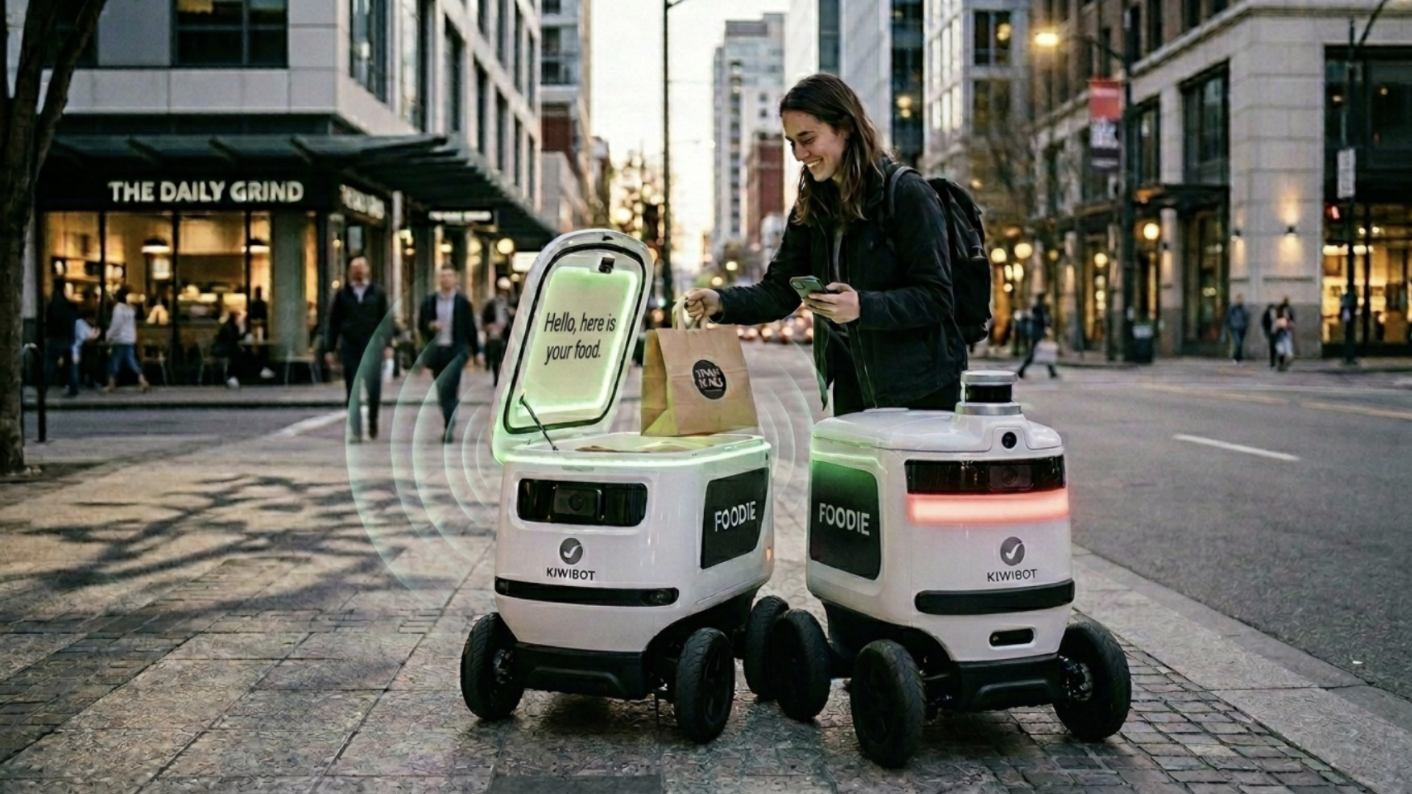
The ideal robotic-delivery handoff feels like a service that already knows you, talks to you, and proves itself in under 60 seconds. The customer is CONFIDENT & EXCITED: informed, satisfied, in control, connected, curious, and trusting. The robot stops being a machine on a sidewalk and becomes a recognized, well-branded teammate that does the last meter without losing the warmth of a human courier.

6Sectors
6Emotional drivers
6Benefits / features
8Sensory cues
INFORMEDIS PERSONALEFFORTLESSIS EASYREASSUREDENSURESFOOD QUALITYREWARDEDIS AFFORDABLEUPDATED &PREPAREDISCITY-PREPAREDRECOGNIZEDISDISTINCTIVELive ETA matches realityPush: “your robot is here”Clear in-app instructionsOne-tap unlockBrand-themed app screenVisible price breakdownRobot detects me on approach and reacts — acknowledges and is lid-readyTap-to-open lidAudible arrival chimeEasy-grip lid handleFriendly LED faceSoft greeting soundClear pickup zone markerSealed compartmentInsulated cargo bayTamper-evident stickerStatus LED red→green on arrivalConsistent ETA vs. promiseNo-friction refund flow$0 tip line on receiptTotal visible upfrontClear $ delta vs. humanNo-tip badgeHonest receipt — no hidden feesSmooth curb cutsWeatherproof bodyPedestrian-friendly pacePauses at crosswalksAccessible building entriesWell-lit night pathDistinctive livery & logoVisible logo on every angleRecognizable from a distanceCharacter / personality cuesBranded soundSensorycuesIt…I am…I feel…CONFIDENT&EXCITEDinformed · satisfied · in controlconnected · curious · trusting

Tap the center for the I feel… core, or any sector for its sticky notes.

Original data sticky (yellow)Overarching positive idea (pink)It-is feature (cyan)Sensory cue (warm)Core emotion (I feel…)

The six sectors

Each sector pairs a benefit with a feature

SectorI am…It…
1INFORMED & GUIDEDIS PERSONAL & CLEAR
2EFFORTLESS & WELCOMEDIS EASY & ACCESSIBLE
3SAFE & SATISFIEDENSURES FOOD QUALITY · IS RELIABLE
4REWARDED & SAVINGIS AFFORDABLE & FAIR
5UPDATED & PREPARED · AT HOMEIS CITY-PREPARED
6RECOGNIZED & FAMILIARIS DISTINCTIVE & IDENTIFIABLE

Section 4.2

I feel…

Six emotional drivers anchoring the core CONFIDENT & EXCITED state. Each traces to ≥ 2 matrix rows.

I feel informed. — photo 1Image 1 of 4

I feel…

I feel informed.

Source rows

Row 5 (Daniela), Row 6 (Camille), Row 8 (Lauren).

Sensory cue

Sound — push notification + audible arrival chime; sight — Live ETA matching reality.

Behavioral signal

Customer stops checking the phone repeatedly; arrival doesn’t surprise them.

Design implication

Match human-courier tracking fidelity, then exceed it with a confirmed audio cue at arrival.

I feel satisfied. — photo 1Image 1 of 4

I feel…

I feel satisfied.

Source rows

Row 1 (Real Tacos), Row 2–3 (GT students), Row 4 (Uber Eats user — no damage).

Sensory cue

Whole-experience — the pickup felt smooth end to end: on-time arrival, frictionless unlock, and intact food at the handoff.

Behavioral signal

Customer doesn’t open a support ticket; doesn’t post a complaint.

Design implication

Satisfaction is the floor, not the ceiling. Reliability + food integrity must be invisible — the customer should never have to think about them.

I feel in control. — photo 1Image 1 of 2

I feel…

I feel in control.

Source rows

Row 5 (Daniela: real-time tracking), Row 7 (Henry: pickup spot), Row 8 (Lauren: pickup-point flexibility).

Sensory cue

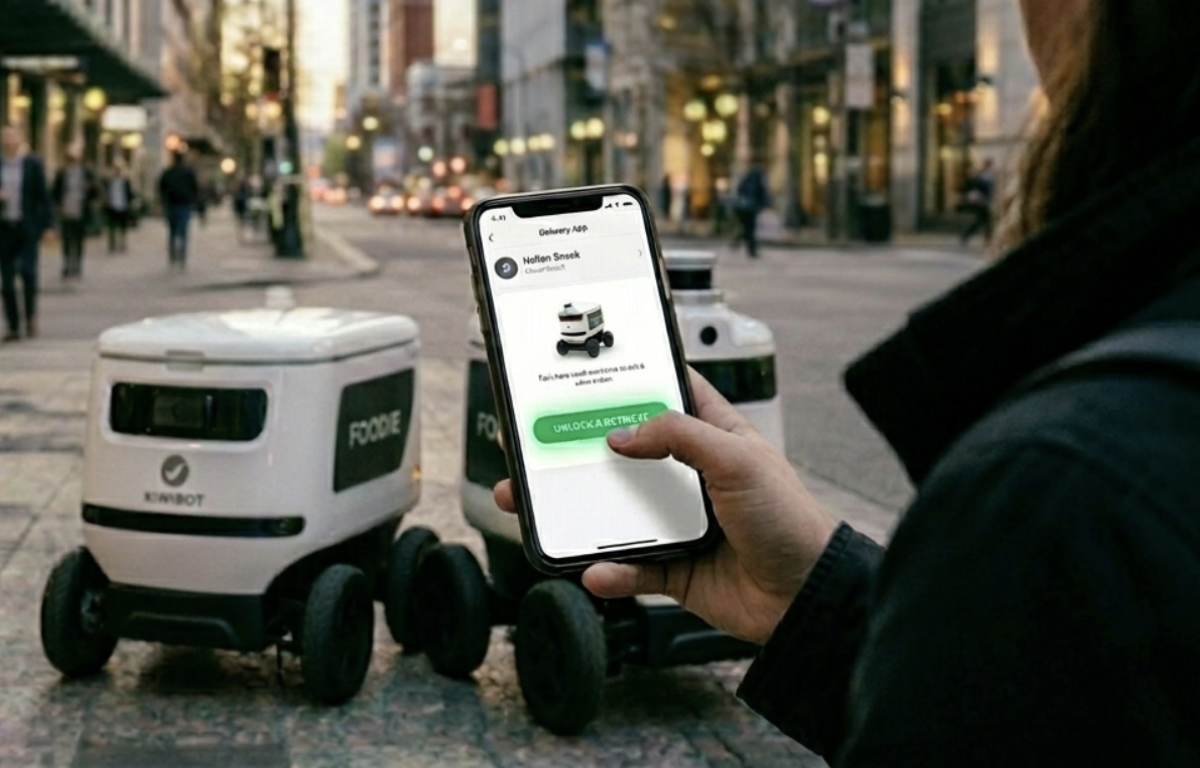
Sight — clear pickup-zone marker; touch — one-tap unlock that works on the first try.

Behavioral signal

Customer chooses time and place; doesn’t feel rushed by the 10-minute wait window.

Design implication

Flexibility at pickup (location, timing) is a control lever, not a luxury. Static fixed-spot models break this driver for time-pressed users.

I feel connected. — photo 1Image 1 of 4

I feel…

I feel connected.

Source rows

Row 6 (Camille: missed thank you), Row 8 (Lauren: don’t know if to talk), Row 13 (sensory cues: silence on sidewalk).

Sensory cue

Social-gaze — robot acknowledges the approaching customer (LED face, soft greeting, name on screen).

Behavioral signal

Customer slows less at approach, walks up confidently, smiles at the unit.

Design implication

Two-way social signaling matters even when the technical handoff is silent. The absence of warmth is itself a signal — a negative one.

I feel curious. — photo 1Image 1 of 4

I feel…

I feel curious.

Source rows

Row 8 (Lauren: identity / story value), Row 9 (Maximo: “funny but weird”), Row 13 (sensory cues: initial curiosity).

Sensory cue

Sight — distinctive livery, branded character cues, recognizable silhouette.

Behavioral signal

Customer takes a photo, shows a friend, posts to Instagram on the first encounter.

Design implication

Curiosity is the gateway to first-time use, but doesn’t sustain repeat trial. Convert curiosity into a structural cue — app-side opt-in (Op 1) or sustainability surface (Op 5).

I feel trusting. — photo 1Image 1 of 2

I feel…

I feel trusting.

Source rows

Row 9 (Maximo: distrusts apps), Row 10 (UMAI: needs commercial transparency), Row 12 (cultural probes: trust broken by mismatch).

Sensory cue

Sight — visible price breakdown, no-tip badge, honest receipt; sound — branded sound on arrival.

Behavioral signal

Customer opts in to robotic delivery again — the second order is the trust test.

Design implication

App-to-fulfillment mismatch (notification says robot, cyclist arrives) is the largest trust-killer in our data. Design out the mismatch, then surface savings transparently.

Section 4.3

I am…

Six benefits — what the customer becomes through the experience. One per Lextant sector.

I am informed and guided. — photo 1Image 1 of 4

I am…

I am informed and guided.

Sector chips (verbatim from SVG)

informed · in the loop · knows me · oriented & guided · in sync · notified on time · communication · signals · aware of the price · intuitive · clear

Source rows

Row 5 (Daniela), Row 6 (Camille), Row 8 (Lauren).

Sensory cue

Push notification: ‘your robot is here’; live ETA matching reality; brand-themed app screen.

Behavioral signal

The customer doesn’t have to ask ‘where is it?’ or ‘what do I do?’. The path through the order flow is decision-light.

Design implication

Make the robot delivery surface as easy to find as a ‘schedule order’; treat in-app communication as a first-class feature.

I am in an effortless experience. — photo 1Image 1 of 3

I am…

I am in an effortless experience.

Sector chips (verbatim from SVG)

in control · welcomed by the robot · comfortable · flexible service · in flow · at ease

Source rows

Row 6 (Camille), Row 7 (Henry: workflow regression), Row 8 (Lauren: pickup-point flexibility).

Sensory cue

Tap-to-open lid; easy-grip lid handle; clear pickup zone marker.

Behavioral signal

The customer’s existing workflow doesn’t break. Pickup fits between meetings, classes, rain.

Design implication

‘In flow’ is incompatible with fixed pickup spots and 10-minute wait windows for users whose schedules don’t bend. Flex these for high-frequency customers.

I am safe and satisfied. — photo 1Image 1 of 3

I am…

I am safe and satisfied.

Sector chips (verbatim from SVG)

safe · served fresh · is predictable · accurate & precision · reliable · consistent · secure experience · precise

Source rows

Row 1 (Real Tacos), Row 4 (Uber Eats user), Row 11 (Subway GT).

Sensory cue

Sealed compartment; insulated cargo bay; tamper-evident sticker; status LED red→green on arrival.

Behavioral signal

The customer’s expectation calibrates upward — they trust the next order will be the same as this one.

Design implication

Reliability is invisible when it works and catastrophic when it fails. Engineer for the long tail (sidewalk obstacles, geofence boundaries, signal loss) before scaling.

I am rewarded. — photo 1Image 1 of 4

I am…

I am rewarded.

Sector chips (verbatim from SVG)

price-aware · tip-free · saving · rewards me · affordable or cheap · fairly treated

Source rows

Row 7 (Henry: ‘no tipping’), Row 9 (Maximo: prices high), Row 5 (Daniela: ‘$2 off’).

Sensory cue

$0 tip line on receipt; total visible upfront; clear $ delta vs. human courier.

Behavioral signal

The customer chooses robot delivery on price, then stays for the experience.

Design implication

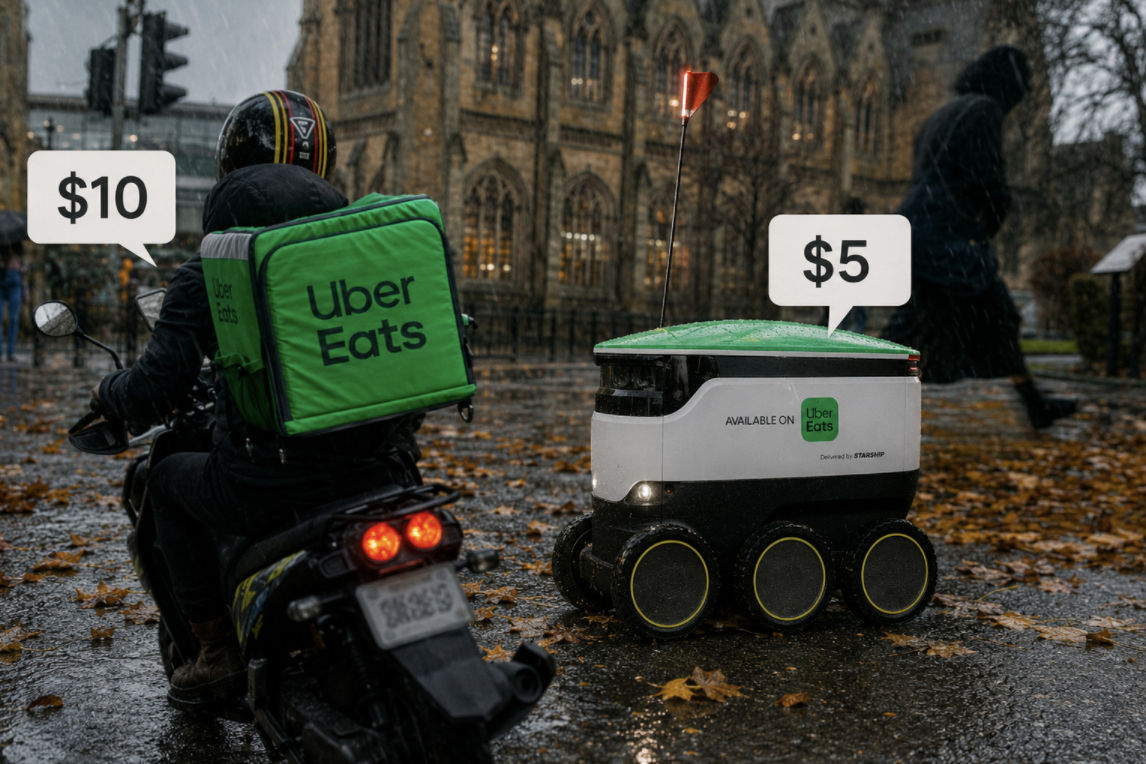
Price advantage must be visible at the moment of choice, not in the receipt after. Don’t dilute the no-tip position with platform fees that recover the savings elsewhere.

I am updated & prepared. — photo 1Image 1 of 2

I am…

I am updated & prepared.

Sector chips (verbatim from SVG)

prepared · at home in my building · integrated, cohesive, connected · respected as a pedestrian

Source rows

Row 6 (Camille: setback), Row 7 (Henry: building entry), Row 11 (Subway GT: closed environments).

Sensory cue

Smooth curb cuts; pedestrian-friendly pace; pauses at crosswalks; accessible building entries; well-lit night path.

Behavioral signal

The customer doesn’t change their building, neighborhood, or schedule to accommodate the robot.

Design implication

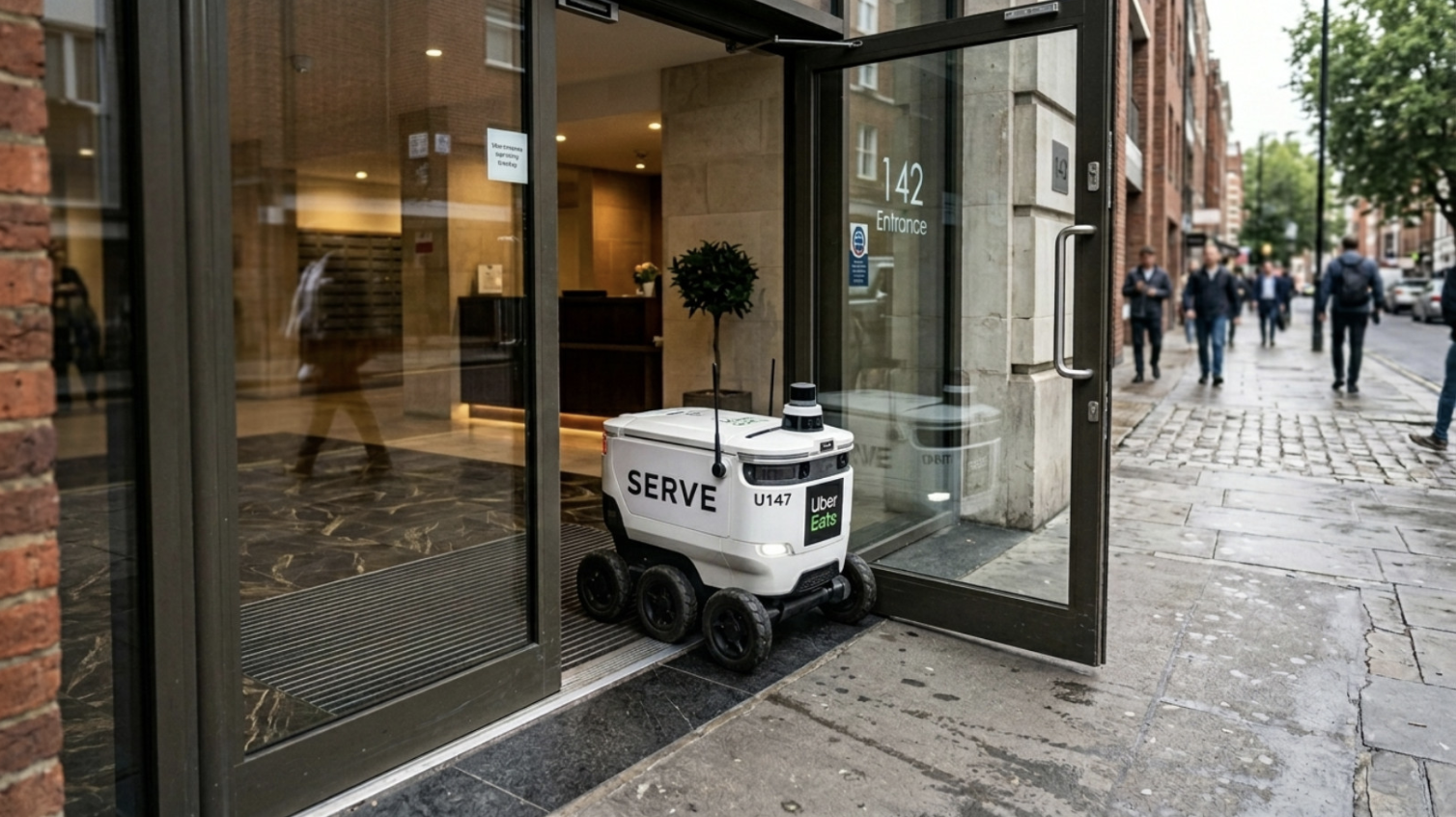
‘At home’ is an infrastructure conversation. Building integration (Op 3) is the unlock; until then, the pickup-spot must adapt to the customer.

I am recognized. — photo 1Image 1 of 4

I am…

I am recognized.

Sector chips (verbatim from SVG)

recognized · brand-aware · familiar with the brand · loyal (I’d order again)

Source rows

Row 8 (Lauren: Instagram), Row 9 (Maximo: aware not adopting), Row 13 (brand identity does not survive).

Sensory cue

Distinctive livery & logo; visible logo on every angle; recognizable silhouette from a distance; branded sound.

Behavioral signal

The customer points at the robot and says ‘Uber Eats’ — not ‘a delivery robot’.

Design implication

The robot is the largest piece of brand real estate Uber Eats currently underuses. Convert sidewalk presence into app trial via a recognizable identity.

Section 4.4

It…

Six features — what the offering must deliver. The what; opportunities in § 5.2 are the how.

It is personal and clear. — photo 1Image 1 of 2

It…

It is personal and clear.

Sector chips (verbatim from SVG)

It is personal · It is a synchronized system · It is intuitive · It listens · It anticipates · It keeps me informed

Source rows

Row 5 (Daniela: discoverability gap), Row 8 (Lauren: confused), Row 12 (cultural probes: 5/5 failed).

Sensory cue

Brand-themed app screen; clear in-app instructions; one-tap unlock.

Behavioral signal

The customer completes the order without leaving the app to figure something out.

Design implication

Personalization isn’t decoration — it’s the difference between a chosen service and a tolerated one. Anticipation > reaction. The system should know last delivery, building quirks, preferred pickup spot.

It is easy and accessible. — photo 1Image 1 of 3

It…

It is easy and accessible.

Sector chips (verbatim from SVG)

Easy · accessible · choose robot delivery · It is welcoming · It greets me

Source rows

Row 6 (Camille: tap-to-open confusing), Row 7 (Henry: lid stuck), Row 8 (Lauren: pickup-spot fixed and far).

Sensory cue

Tap-to-open lid; audible arrival chime; easy-grip lid handle; friendly LED face; soft greeting sound; clear pickup zone marker.

Behavioral signal

First-time users complete the unlock without watching a tutorial. Returning users do it in under 5 seconds.

Design implication

Easy means no instruction needed at the moment of use. If a screen has to explain the lid, the lid lost. Choose-ability — opt out and back in — is part of ‘easy’.

It ensures food quality. — photo 1Image 1 of 3

It…

It ensures food quality.

Sector chips (verbatim from SVG)

Keep the food quality · It is reliable · It is precise · It is sealed · It works every time · It is consistent

Source rows

Row 1 (Real Tacos: minimum-viable load), Row 4 (Uber Eats user: no damage), Row 12 (cultural probes: damaged-meal incident).

Sensory cue

Sealed compartment; insulated cargo bay; tamper-evident sticker; status LED red→green on arrival; no-friction refund flow.

Behavioral signal

The customer doesn’t peek at the food before leaving — trust in the seal is automatic.

Design implication

Food quality is the table-stakes feature that scales the system. One bad delivery breaks trust for ten future ones — engineer the cargo bay and SLA before scaling.

It is affordable and fair. — photo 1Image 1 of 4

It…

It is affordable and fair.

Sector chips (verbatim from SVG)

It is more affordable · It is tip-free · It is honest about the total · It rewards me · It is upfront · It is fair

Source rows

Row 5 (Daniela), Row 7 (Henry: ‘no tipping’), Row 9 (Maximo: prices higher than restaurant).

Sensory cue

$0 tip line on receipt; total visible upfront; clear $ delta vs. human courier; no-tip badge; honest receipt.

Behavioral signal

The customer compares prices once, sees the savings, and stops comparing.

Design implication

Fairness is the second-order effect of transparency. Hidden platform fees that recover the no-tip savings invalidate the entire driver.

It is city-prepared. — photo 1Image 1 of 3

It…

It is city-prepared.

Sector chips (verbatim from SVG)

It is city-prepared · It respects pedestrians · It is weather-proof · It is building-aware

Source rows

Row 6 (Camille: setback), Row 7 (Henry: building entry), Row 10 (UMAI: urban concerns), Row 11 (Subway GT: closed environments).

Sensory cue

Smooth curb cuts; weatherproof body; pedestrian-friendly pace; pauses at crosswalks; accessible building entries; well-lit night path.

Behavioral signal

The robot doesn’t disrupt the sidewalks it operates on — pedestrians don’t notice it as a problem.

Design implication

City-readiness is partly the robot, partly the city. The platform must invest in both: hardware that’s polite, partnerships that make the city polite back.

It is distinctive and identifiable. — photo 1Image 1 of 3

It…

It is distinctive and identifiable.

Sector chips (verbatim from SVG)

It is distinctive, identifiable & recognizable · It has personality · It is well-branded · It is on my side

Source rows

Row 8 (Lauren: disambiguation), Row 9 (Maximo: aware), Row 11 (Subway GT: clustered zones), Row 13 (brand does not survive).

Sensory cue

Distinctive livery & logo; visible logo on every angle; recognizable silhouette from a distance; character/personality cues; branded sound.

Behavioral signal

The customer points at the robot and says ‘Uber Eats’. A new customer downloads the app because of the robot.

Design implication

Distinctiveness has two jobs: disambiguate which robot is yours (Op 6), and carry brand identity from sidewalk back into the app.

Section 4.5

Sensory clues — Expected features

Eight cues distributed across sight, sound, touch, and social-gaze — the bridge between drivers and behavior.

Distribution across sensory channels

Sight4cues
Sound1cue
Touch2cues
Social-gaze1cue
Sight

Live ETA matches reality.

Source rows

Row 5 (Daniela), Row 6 (Camille), Row 12 (cultural probes mismatch).

Behavioral signal

Customer stops refreshing the app; arrival doesn’t surprise them.

Design implication

ETA accuracy is the trust contract. A 3-minute miss is forgivable; a notification-vs-cyclist mismatch is not.

Sound

“Your robot is here” — push + audible chime.

Source rows

Row 6 (Camille: no sound), Row 8 (Lauren: confused timing), Row 13 (silence on sidewalk).

Behavioral signal

Customer looks up at exactly the right moment.

Design implication

Audio + push is two cues for the same event. Both are required — neither is sufficient.

Touch

One-tap unlock that works on the first try.

Source rows

Row 6 (Camille: phone-on-lid confusing), Row 7 (Henry: lid stuck), Row 8 (Lauren: tap zone unspecified).

Behavioral signal

Customer unlocks in one motion, no second attempt.

Design implication

Tap surface needs to be visually obvious AND mechanically generous. Precision-required taps fail when the customer is holding a phone and a coffee.

Social-gaze

Friendly LED face + soft greeting sound.

Source rows

Row 6 (Camille: missed thank you), Row 8 (Lauren: don’t know if to talk), Row 13 (silence on sidewalk).

Behavioral signal

Customer makes eye contact with the screen; feels less self-conscious.

Design implication

The robot doesn’t need a face — but it needs to acknowledge. Social-gaze cues are how the customer knows the robot knows they’re there.

Sight

Sealed compartment + tamper-evident sticker.

Source rows

Row 4 (Uber Eats user: no damage), Row 12 (cultural probes: damage incident), Row 1 (Real Tacos: sealed at load).

Behavioral signal

Customer doesn’t peek at the food before walking away.

Design implication

The seal is both a physical control and a visual signal. Tamper-evident stickers are cheap; the trust they produce is not.

Sight

$0 tip line + total visible upfront.

Source rows

Row 5 (Daniela: ‘$2 off’), Row 7 (Henry: ‘no tipping’), Row 9 (Maximo: distrusts receipts).

Behavioral signal

Customer doesn’t open the receipt to check the math.

Design implication

Surface the total AND the savings vs. human courier at the moment of choice. Receipts are forensic; order screens are persuasive.

Touch

Pedestrian-friendly pace + pauses at crosswalks.

Source rows

Row 10 (UMAI: urban concerns), Row 11 (Subway GT: closed environments), Row 13 (GT pedestrian observations).

Behavioral signal

Pedestrians don’t change their walking line.

Design implication

‘Pace’ is partly speed, partly signaling. A robot that slows visibly at intersections stays safe AND signals it’s safe.

Sight

Distinctive livery + recognizable silhouette from a distance.

Source rows

Row 8 (Lauren: brand visibility), Row 9 (Maximo: aware not adopting), Row 13 (brand does not survive).

Behavioral signal

A passer-by points at the robot from 30 ft away and says ‘Uber Eats’.

Design implication

The robot is the largest piece of brand real estate Uber Eats owns at street level. Generic gray-white units cede that real estate.

Up next

Section 5 · Strategic Outputs

Personas, opportunities mapped to UN SDGs, and the recommendations the team is shipping next.